The Losses for Which There is No Funeral


Occupational culture, identity, and the grief of losing the uniform
There he was—a young police officer who desperately wanted to return to duty.
He had survived the shooting.
What he had not survived unchanged were the years of calls that came before it.
Call after call. Trauma after trauma. Experiences that had accumulated until his nervous system could no longer carry what was being asked of it.
He committed himself to therapy. He worked hard. He wanted to heal.
And he wanted his life back.
But eventually, it became clear that returning to duty would not be possible.
That realization brought another kind of loss.
He wasn’t simply leaving a job.
He was losing a career he loved and from which he had derived tremendous meaning and purpose.
He was losing a role, a routine, a community, a calling, and an identity he had come to understand as part of who he was.
Had he died, his occupational culture would have known exactly what to do.
There would have been a sea of blue.
Flags would have been displayed. Dress uniforms worn. Wreaths laid. An honor guard would have stood watch. A procession would have marked his service. Taps would have sounded.
Those rituals would have communicated:
You belonged to us.
Your service mattered.
Your sacrifice mattered.
But he survived.
And there was no ritual for what he lost.
No ceremony.
No formal recognition.
No moment that acknowledged the ending of the life he thought he would continue living.
At first, there was still connection to the world he had left behind. Former colleagues checked in. They shared stories and maintained the connection to the culture that had once surrounded him every day.
Over time, those connections faded.
The calls became less frequent.
Then they stopped.
The loss became larger.
He had lost the uniform, but he was also losing the community that came with it.
Meaning.
Purpose.
Belonging.
Identity.
The future he had imagined.
He was alive, but he was grieving a life that had ended.
There was no funeral for that life.
No ritual.
No closure.
Just emptiness and loss.
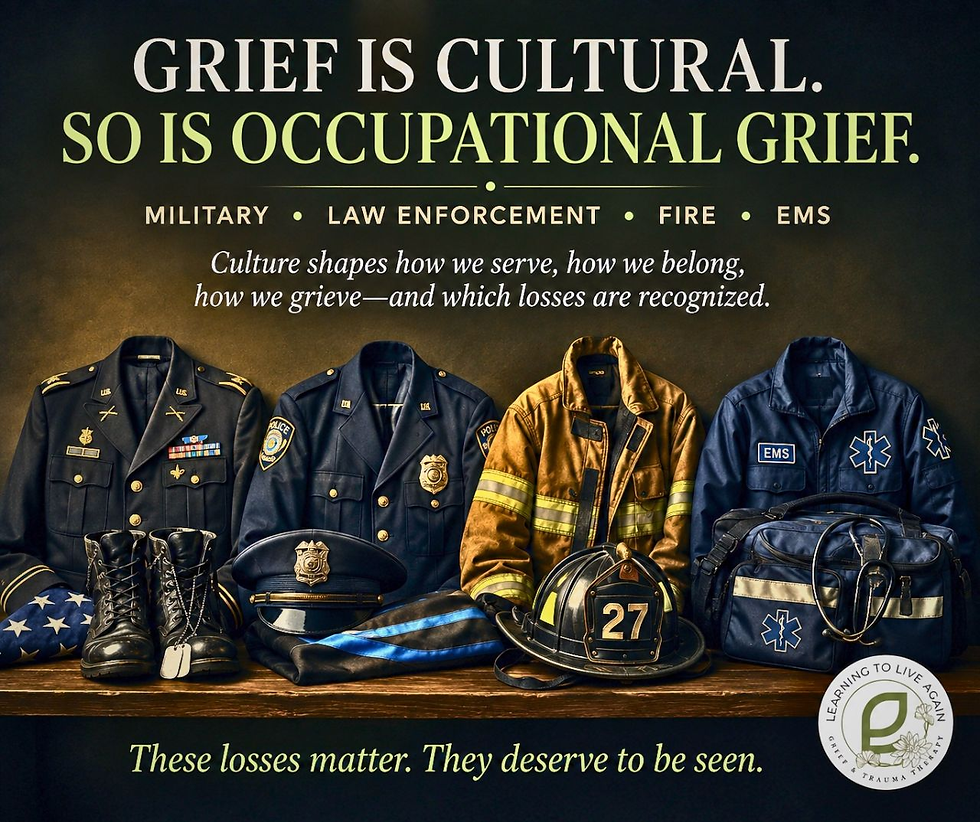
This is occupational grief.

Comments