Grief Fog Is Real: Why Grief Makes It So Hard to Think

“Was I dreaming, or did this really happen?”
There is a reason grief can leave us feeling confused, forgetful, and disconnected from reality.
One of the most common grief symptoms I encounter in the counseling room is something I call grief fog.
People tell me they cannot concentrate. They walk into a room and cannot remember why they went there. They lose their train of thought in the middle of a sentence. They read the same paragraph three times and still have no idea what they just read.
They forget appointments. Misplace things. Struggle to make decisions that once required almost no thought.
Sometimes they cannot clearly remember entire stretches of time surrounding the death.
And in the earliest days of loss, that fog can add another layer to the disbelief that is already present.
Was I dreaming?
Did this really happen?
How can they actually be gone?
And eventually, another frightening question may creep in:
What is wrong with me?
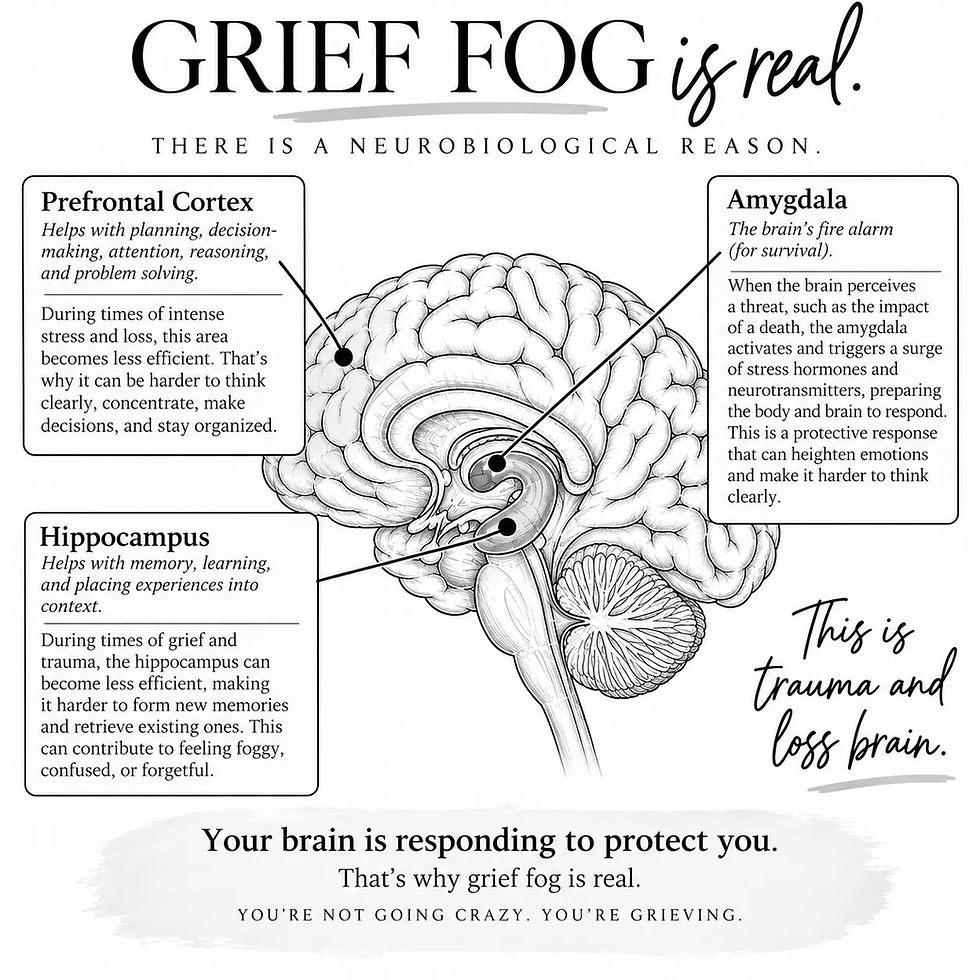
Grief fog is real.
There are neurobiological reasons that thinking, concentrating, and remembering can become more difficult when the brain and body are responding to overwhelming stress and loss.
When the Brain Sounds the Alarm
I often explain it to clients this way:
Think of the amygdala as the brain’s fire alarm.
When something happens that the brain perceives as threatening or overwhelming, the body’s stress-response systems activate. Stress hormones and neurotransmitters help prepare the brain and body to respond to danger (Arnsten, 2009; Roozendaal et al., 2009).
That response is incredibly useful when we need to survive something.
It is considerably less useful when we are trying to remember where we put the car keys.
During periods of intense stress, the brain begins prioritizing survival over some of the higher-order functions we normally depend upon.
The prefrontal cortex helps us with attention, reasoning, planning, organization, judgment, decision-making, and impulse control. Under intense stress, those functions can become less efficient (Arnsten, 2009).
That’s why something as ordinary as deciding what to eat for dinner can suddenly feel like an enormous task.
Then there is the hippocampus, which plays an important role in learning, memory, and placing experiences into context. Stress can affect hippocampal functioning and memory processes, contributing to difficulty forming, organizing, or retrieving memories (Roozendaal et al., 2009).
I tell clients to imagine that the stress response creates a layer of fog around the systems they normally rely upon to organize and retrieve information.
The information may still be there.
But reaching it can suddenly feel much harder.
That’s grief fog.
Trauma and Loss Brain
Not every death is experienced as trauma in the same way, but loss can certainly be traumatic—and some deaths are profoundly traumatic.
A sudden death.
A violent death.
A suicide.
An accident.
A prolonged medical crisis.
Watching someone you love deteriorate.
Providing intensive caregiving while anticipating what is coming.
Even when the circumstances surrounding a death are not traumatic, the loss itself can still be an enormous stressor. Bereavement research has identified changes in neural systems involved in emotional processing, memory, reward, and cognitive control as the brain adapts to loss (Evstigneev et al., 2026; O’Connor, 2019).
The world the brain understood yesterday may no longer exist today.
Your person was here.
Now they are not.
And somehow, your brain has to comprehend that.
That takes time.
Was I Dreaming, or Did This Really Happen?
This is one of the parts of grief I think we sometimes underestimate.
Knowing someone died and comprehending that they are gone are not necessarily the same thing.
You can know the facts.
You may have been in the hospital room.
You may have planned the funeral.
You may have signed paperwork.
You may have watched the casket close.
And still wake up the next morning and, for one brief moment, expect them to be there.
Then you remember.
They’re gone.
The loss becomes real again.
The grieving brain has to repeatedly encounter and integrate a reality that does not yet fit the world it knew before. Contemporary grief neuroscience suggests that adapting to bereavement involves reconciling deeply learned expectations about the presence of someone we love with the new reality of their absence (O’Connor, 2019).
That is one reason grief can feel so surreal.
It is also why I believe we need to give ourselves far more grace during those early days and weeks than we often do.
Your brain is trying to understand something your heart may not yet be ready to comprehend.
The Fog Doesn’t Follow a Straight Line
Like so much of grief, grief fog can come and go.
You may have a week when you feel clearer and begin thinking, I’m finally doing better.
Then something happens.
An anniversary.
A song.
A smell.
A piece of mail addressed to them.
Someone asks about them.
You instinctively reach for your phone to call them.
And suddenly, your nervous system responds again and the fog seems to roll back in.
That does not mean you have gone backward.
Grief is not linear.
It shifts.
Surges.
Twists and turns.
Ebbs and flows.
Softens and intensifies.
As the reality of the loss becomes more integrated into your understanding of your life, many people find that the fog gradually becomes less consuming. The grieving brain and body gradually adapt to a world in which the person is no longer physically present (O’Connor, 2019).
Concentration may improve.
Decisions may become easier.
Memories may become more accessible.
There may still be foggy days.
But eventually, there can be more clear ones between them.
“You Mean I’m Not Going Crazy?”
I’ve heard some version of that question countless times in the counseling room.
Sometimes people are genuinely frightened by what grief has done to their ability to think.
Why can’t I remember anything?
Why can’t I make a decision?
Why do I feel so scattered?
Why don’t I feel like myself?
Once people understand what grief can do to attention, memory, concentration, and decision-making, I often see relief wash across their faces.
There is finally an explanation for something that has frightened them.
And my answer is simple:
No. You’re not going crazy.
You’re grieving.
Understanding what is happening inside us does not take the pain away.
But sometimes it can take away the fear that something is terribly wrong with us.
And that matters.
Because understanding is where we begin.
When we understand what grief may be doing to our brain and body, we can stop fighting ourselves for responding to something extraordinarily difficult.
We can begin learning how to carry it.
And, eventually, we can begin learning to live again.
References
Arnsten, A. F. T. (2009). Stress signalling pathways that impair prefrontal cortex structure and function. Nature Reviews Neuroscience, 10, 410–422. https://doi.org/10.1038/nrn2648
Evstigneev, S. R., O’Connor, M.-F., Wilhelm, F. H., Blum, D., Slavich, G. M., & Seiler, A. (2026). Grief and bereavement: A pre-registered systematic review of neuroimaging studies. Neuroscience & Biobehavioral Reviews, 182, 106535. https://doi.org/10.1016/j.neubiorev.2025.106535
O’Connor, M.-F. (2019). Grief: A brief history of research on how body, mind, and brain adapt. Psychosomatic Medicine, 81(8), 731–738. https://doi.org/10.1097/PSY.0000000000000717
Roozendaal, B., McEwen, B. S., & Chattarji, S. (2009). Stress, memory and the amygdala. Nature Reviews Neuroscience, 10, 423–433. https://doi.org/10.1038/nrn2651



Comments