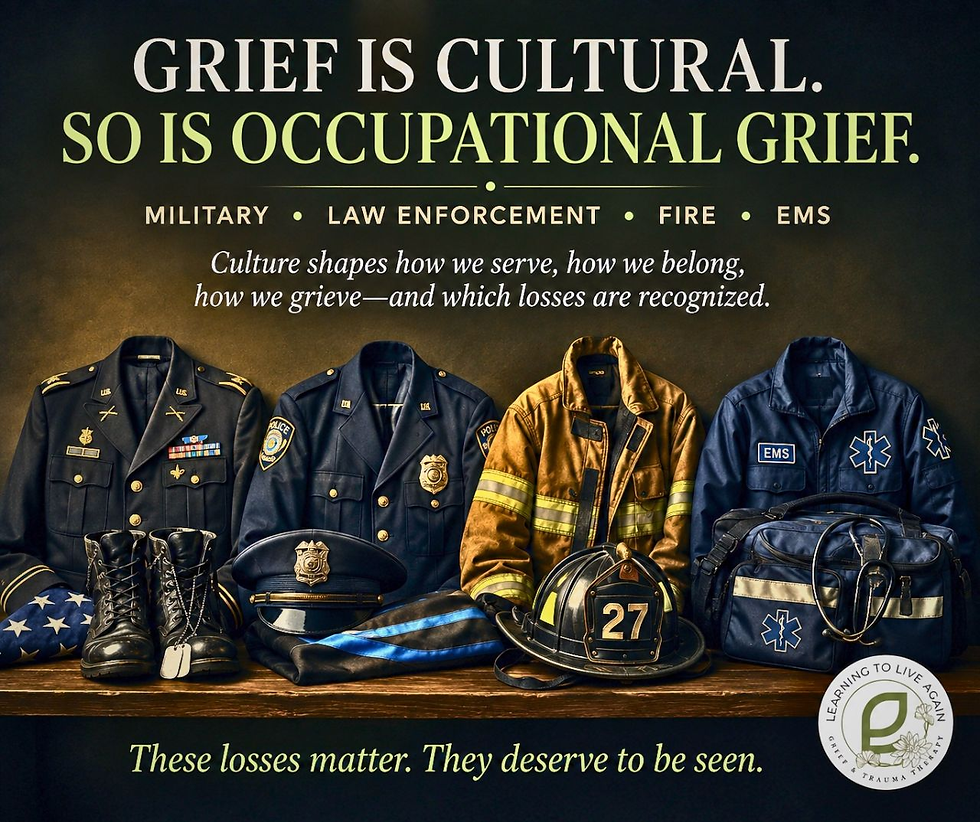
Grief is cultural. So is occupational grief.


Grief is cultural. So is occupational grief.
When we talk about multiculturalism in counselor education, we often think about race, ethnicity, religion, nationality, and geographic community.
We should.
But our understanding of culture cannot stop there.
Military members and first responders belong to distinct occupational cultures, and within those cultures are subcultures shaped by branch, department, region, role, and generations of tradition.
They have their own language. Their own values. Their own expectations. Their own symbols and traditions.
They also have deeply held understandings of service, sacrifice, strength, vulnerability, belonging,
and loss.
We can see these cultures perhaps most clearly in the ways they honor their dead.
Flags are displayed with profound meaning.
Dress uniforms are worn.
Badges are covered.
Wreaths are laid.
Honor guards stand watch.
Processions bring communities to a standstill.
Bagpipes play.
Taps sounds.
Even within these occupational cultures, there are subcultures.
Branch, department, region, unit, and local history influence the rituals used to honor someone who has died.
Yet the meaning behind these rituals is remarkably similar.
You belonged to us.
Your service mattered.
Your sacrifice mattered.
We recognize this loss.
But what happens when the person doesn’t die?
What happens when PTSD makes returning to duty impossible? Or when an injury ends a career?
Where are the rituals then?
There may be no flag.
No dress uniform.
No honor guard.
No procession.
No gathering of the community to acknowledge everything that has been lost.
And yet, that person may be grieving the loss of identity, purpose, routine, camaraderie, status, physical ability, community, and the future they believed they would have.
They may be grieving the loss of the person they understood themselves to be.
The person survived. But something significant still died.
This is where multicultural competence and grief competence intersect.
If we are preparing counselors to understand grief through a multicultural lens, occupational cultures cannot remain an afterthought.
Counselors must understand the culture in which those experiences occur.
Culture shapes how we serve, how we belong, and how we grieve.
And culture can even shape which losses are recognized as worthy of grief.
For military members and first responders, this matters enormously. The same culture that provides generations of ritual, symbolism, and community when one of its members dies may have far fewer ways to recognize the profound non-death loss of the uniform, career, identity, and community.
Our grief education must make room for the losses for which there is no funeral.

Comments